

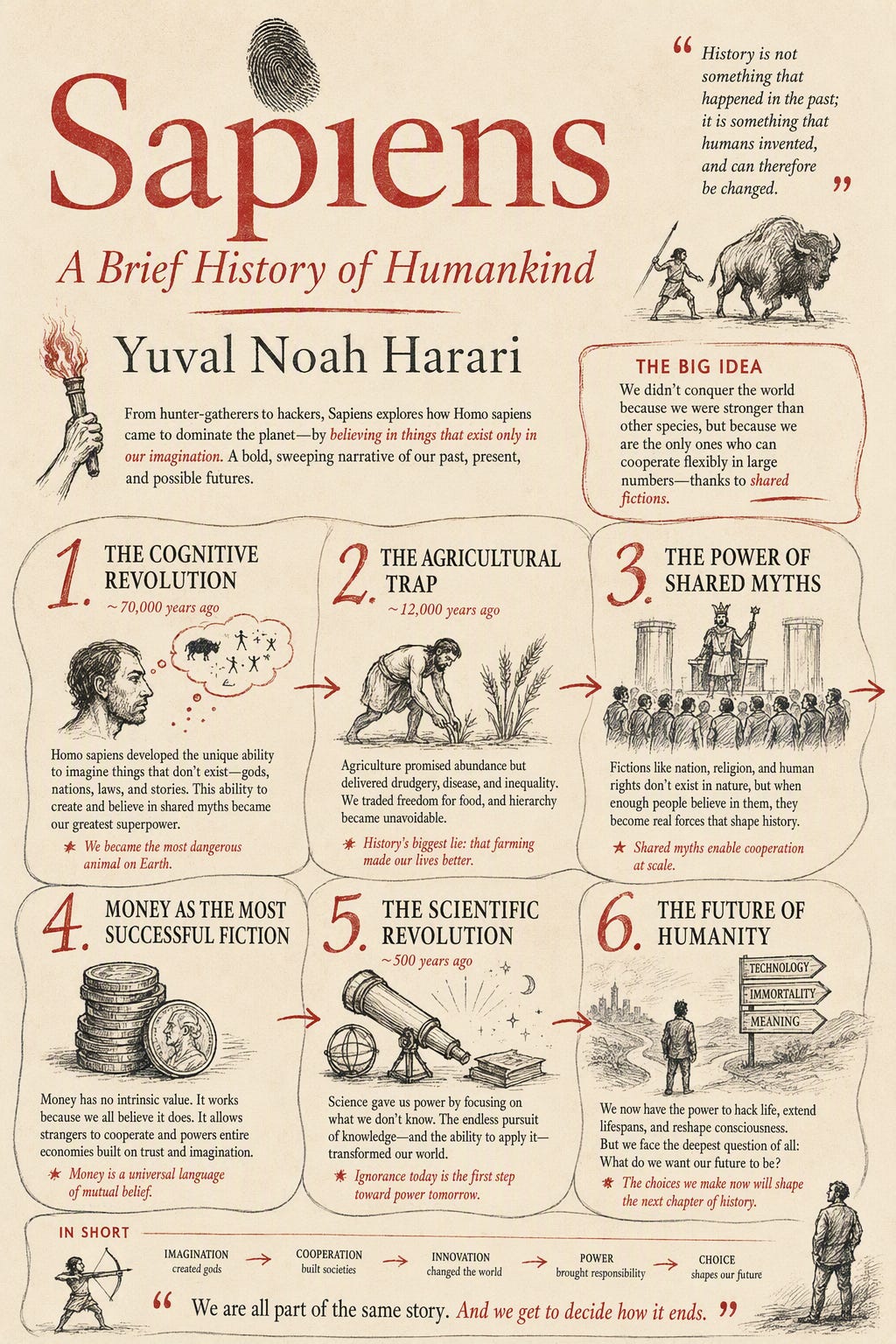
This book is criminally underused as a life tool. Most people read it and say “wow fascinating” and go back to their spreadsheets. Wrong move. This is a manual for understanding the invisible software running your life. If you are a millennial grinding in a corporate job wondering why the game feels rigged. this book explains exactly who built the game. how. and why. Underrated. Read this. You will not need the actual book after.
OK. Let us start at the actual beginning.
Not your beginning. Not your parents’ beginning. The real one.
About 13.5 billion years ago matter and energy appeared. Physics happened. Then chemistry. Then biology. Then one very unremarkable ape climbed down from a tree in Africa and something went wrong in its brain.
Wrong in the best possible way.
That ape was us.
But here is what almost every history class skips. We were not always the most dangerous thing walking around. For most of our existence we were prey. We were the medium-sized mammal getting bullied off his kill by hyenas. We were nobody special.
Go back 100,000 years. There are at least six different human species walking the earth. Six. Homo erectus. Homo neanderthalensis. Homo soloensis. Homo floresiensis. And us. Homo sapiens. We are not special yet. Just one of the pack. Somewhere in the middle of the food chain. Cracking bones with rocks to get the marrow after the lions already ate the good parts.
That is your ancestor. Bone marrow. Leftovers.
Then something happened about 70,000 years ago. Something in the wiring of the Homo sapiens brain changed. Scientists call it the Cognitive Revolution. What it really means is this. we started thinking in a completely new way.
Not just thinking about real things. Thinking about things that do not exist.
Other animals can communicate. A monkey can warn his friends about a snake. He can say in monkey language. “snake in the tree.” Fine. Useful. Real. But a monkey cannot say “the snake is our tribe’s guardian spirit and if we worship it we will be protected in the afterlife.” He cannot imagine that. He cannot believe something that is not physically in front of him.
We can.
And that. right there. is the whole book.
We can tell stories about things that are not real. And more than that. we can get thousands. millions. billions of strangers to believe the same story at the same time.
No other animal does this. A chimpanzee troupe is limited to about 150 members. You cannot get 1,000 chimpanzees to cooperate because you cannot make them believe in a shared fiction. They will only trust what they can smell and touch and groom.
But you can get 1,000,000 humans to cooperate. to work together. to die for each other. if they all believe the same story.
The story of a nation. The story of God. The story of human rights. The story of Nike being cool.
All fiction. All real in their effect.
▓▓▓▓▓▓▓▓▓▓▓▓▓▓▓▓▓▓▓▓▓▓▓▓▓▓▓▓▓▓
MINDTOOL #1: THE FICTION ADVANTAGE
Type: Mental Model
The Idea
Humans dominate Earth not because we are strongest or smartest in raw terms. but because we are the only species that can coordinate massive cooperation through shared stories. The story is not the lie. The story is the technology.
Why It’s an Unfair Advantage
Most people think facts win arguments. They do not. Stories win. Every company that has dominated its market did it with a story first and a product second. Apple did not sell computers. They sold “think different.” Research on persuasion shows narrative activates more brain regions than data. Stories cause behavioral change. Facts cause nodding. The people who control the story control the room. Always. Most of your colleagues are presenting facts. You are leaving power on the table every single meeting.
Install It
Monday morning. You have a meeting. You want buy-in on your project. Do not open with data. Open with a problem your audience has personally felt. Make it vivid. Make it real. Then show your solution as the resolution to that story. You are not selling a project. You are selling a narrative they already want to be inside of. Practice this in one meeting this week. Watch the room change.
▓▓▓▓▓▓▓▓▓▓▓▓▓▓▓▓▓▓▓▓▓▓▓▓▓▓▓▓▓▓
So we are 70,000 years ago. We have this new brain. This gossiping. storytelling. myth-making brain. And we use it to spread. Fast.
Within 10,000 years of the Cognitive Revolution we had moved from Africa to Europe. to Asia. to Australia. And everywhere we went. the large animals went extinct.
This is not a coincidence.
Australia once had giant wombats the size of hippos. Giant kangaroos. Marsupial lions. Within a few thousand years of humans arriving. all of them. gone. North America once had mammoths. horses. giant sloths. Gone within a thousand years of our arrival. We were not arriving. We were invading. We are the asteroid.
And we did all of this before agriculture. before cities. before writing. We were hunter-gatherers with spears and we erased millions of years of evolution wherever we showed up.
Now here is where the book gets honest in a way most people cannot handle.
Those hunter-gatherers. They were not miserable primitives waiting for us to invent civilization and rescue them. The evidence says the opposite.
Hunter-gatherers worked an average of 35 to 45 hours a week. Not 60. They ate a diverse diet of hundreds of different plants and animals. Their bones show they were physically bigger and healthier than the early farmers who came after them. More leisure time. More social connection. Less hierarchy. Less inequality.
They did not live as long because of infant mortality and no medicine. But if you survived childhood. you were probably in better physical shape than you are right now.
Then came farming.
About 12,000 years ago in the Middle East a group of humans started growing wheat. And Harari calls this the worst deal in human history.
Here is why.
Wheat did not save humans. Humans saved wheat.
Think about it from wheat’s perspective. Before farming. wheat was just one grass growing in a small patch of the Middle East. After farming. wheat covers 870,000 square miles of earth’s surface. It is one of the most successful plants in history.
But what did the humans who farmed it actually get?
More calories. But the same calories. over and over. Farmers lived on bread and porridge. Their nutrition was worse than their hunter-gatherer grandparents. Their skeletons are smaller. Their teeth are rotting. The bones show arthritis from bending and digging all day.
And they worked way more. Farming is brutal. repetitive. relentless work. You do not work 35 hours a week on a farm. You work until your body breaks.
Plus. now you own land. The moment you own land. other people want your land. So now you need armies. Now you need kings to command the armies. Now you need taxation to pay the armies. Now you need bureaucracy to collect the taxes.
One handful of wheat seeds. Suddenly you have invented inequality. hierarchy. war. and the entire political system that has oppressed most humans ever since.
▓▓▓▓▓▓▓▓▓▓▓▓▓▓▓▓▓▓▓▓▓▓▓▓▓▓▓▓▓▓
MINDTOOL #2: THE PROGRESS TRAP
Type: Life Lesson / Mental Model
The Idea
More is not always better. Every upgrade in capability or comfort can lock you into a system that demands more from you than it gives back. The trap does not feel like a trap at first. It feels like progress.
Why It’s an Unfair Advantage
This is happening to corporate millennials right now and almost nobody names it. You took a better job with a better salary. You upgraded the apartment. the car. the lifestyle. Now you cannot leave the job because the lifestyle costs too much. You are a modern farmer. You have more than your parents did at your age. and you feel more trapped. Research from Princeton found emotional wellbeing stops meaningfully improving beyond roughly $75,000-$100,000 in annual income. After that. more money buys more stuff. not more happiness. The corporate system was designed. like wheat farming was. to extract maximum labor by making you dependent on it.
Install It
Before your next lifestyle upgrade. pause 48 hours. Ask one question: if I take this new salary or buy this new thing. does my actual daily freedom increase or decrease? Not your status. Not your net worth on paper. Your actual daily freedom. How you spend your Tuesday at 2pm. That is the only real measure of whether an upgrade is progress or a trap.
▓▓▓▓▓▓▓▓▓▓▓▓▓▓▓▓▓▓▓▓▓▓▓▓▓▓▓▓▓▓
OK. So now we have farming. Cities. Kings. Hierarchy. Thousands of years pass. And Harari asks a question that stops most readers cold.
How do you get millions of strangers who have never met each other to cooperate in a complex society?
Think about how genuinely strange this is. You walk into a Starbucks in Tokyo. You have never met the person behind the counter. Never met the franchise owner. Never met the person who grew the beans in Ethiopia. Never met the person who designed the app you paid with.
And yet you cooperate seamlessly. Money changes hands. Coffee changes hands. Trust is exchanged instantly between total strangers.
How?
Three stories have done most of the heavy lifting in human civilization. Money. Empires. and Religion.
Money first. Because this one will properly mess with you.
A dollar bill has no value. Zero. It is cotton and linen. If you were stranded on a desert island with a million dollars in cash you would be no better off than with nothing. The value of money exists entirely in human imagination.
But here is the genius of it. Money is the most universally trusted fiction in human history. Christians and Muslims distrust each other. Both believe in dollars. Conservatives and liberals despise each other. Both accept credit cards. Money is the only story that almost every human on earth has agreed to believe simultaneously.
And it works because it is self-fulfilling. Money has value because you believe it has value because I believe it has value because we all believe it has value. The moment that belief starts collapsing. the money collapses with it. Ask anyone who lived through Zimbabwe’s hyperinflation. People wallpapered their houses with banknotes. That is what money is without collective belief. Expensive wallpaper.
Now religion. Harari is careful here. He is not attacking faith. He is describing function.
Religion in Harari’s framing is a technology for large-scale cooperation. It provides three things that make big societies possible. First. it provides a shared story about why the rules of society are legitimate. If the king says pay taxes because I am king. you might resist. If God says pay taxes because I represent cosmic order. compliance goes up considerably.
Second. it provides comfort in the face of suffering. Societies need people to endure hardship without revolting. Religion tells a story about why suffering is meaningful. That is not manipulation. That is an extraordinarily powerful psychological infrastructure.
Third. it gives strangers a common identity and a shortcut to trust. Two people who have never met can instantly operate together if they share a religious identity. That shortcut is worth more than any background check.
Now empires. Harari makes a point here that is genuinely uncomfortable for people who like clean moral stories.
Empires are terrible. And they also built most of the world you live in. The roads. the legal systems. the languages. the trade routes. the universities. Everything you benefit from was built on someone else’s conquest. The Roman Empire. The British Empire. The Han Dynasty. All of them horrific. All of them foundational.
The awkward truth is that history does not care about your ethics. What survives is what was effective. Empires were effective at spreading culture. language. technology. and legal systems across vast populations. You can hate that and still have to reckon with it.
▓▓▓▓▓▓▓▓▓▓▓▓▓▓▓▓▓▓▓▓▓▓▓▓▓▓▓▓▓▓
MINDTOOL #3: THE SHARED MYTH OPERATING SYSTEM
Type: Framework
The Idea
Every institution you work for and every social structure you operate in runs on shared stories. Not facts. Not logic. Stories. Whoever controls the story controls the institution. This is not metaphor. This is mechanics.
Why It’s an Unfair Advantage
Most people spend their whole career working within the story. The smart ones learn to read the story. identify it. and occasionally write a new one. Tesla did not disrupt the car industry with better engineering first. It disrupted with a better story first. Electric cars were “golf carts” until Tesla made them “the future.” The engineering followed the narrative. Every successful career pivot. every successful product launch. every promotion follows this exact pattern. Rewrite the story first. then deliver the substance.
Install It
Identify the shared myth of your current organization. What story does your company tell itself about why it matters. who it serves. what it stands for? Now ask: does my personal story fit inside that myth? If it does not. you are invisible to the people who promote and reward. Either align your story to theirs. or find an organization whose myth you actually believe in. Misalignment between your story and the company story is exhausting and. long-term. unwinnable. Choose a direction.
▓▓▓▓▓▓▓▓▓▓▓▓▓▓▓▓▓▓▓▓▓▓▓▓▓▓▓▓▓▓
Now we hit the Scientific Revolution. And this is where Harari makes his most contrarian point.
About 500 years ago in Europe. a small group of people started doing something humanity had never systematically done before.
Admitting they did not know things.
That sounds simple. It is not.
For almost all of human history. every civilization believed it already had the important answers. You wanted to know how the universe worked. the Bible told you. The Quran told you. The ancient texts told you. Knowledge was about rediscovering what the elders already knew. Not discovering new things.
Then a handful of Europeans started saying. “Actually. we do not know. Let us find out.”
This tiny shift. this radical admission of ignorance. changed everything.
Galileo looks through a telescope and says everything we thought about the solar system is wrong. Newton decides to actually measure how things fall instead of accepting the Church’s explanation. They are not just curious. They are institutionally heretical. They are saying the old knowledge is not just incomplete. It is unreliable.
This breaks the entire medieval worldview. And in its place grows empiricism. The idea that knowledge comes from observation and experiment. not from authority and tradition.
But here is Harari’s most underrated insight about the Scientific Revolution. Science and Empire grew together. Like twins.
European empires funded science because science made conquest more efficient. Better navigation meant better ships meant better routes to colonies. Better chemistry meant better weapons. Better medicine meant armies that survived long enough to conquer.
And science needed empire too. You cannot study the ecosystems of South America from a library in London. Empires sent scientists everywhere. collected specimens. mapped everything. filled the universities of Europe with the world’s knowledge. and its wealth.
The Scientific Revolution is not a pure story of enlightenment. It is a story of human curiosity and human greed so intertwined you cannot pull them apart.
But what it produced in the end was a civilization with one new belief embedded at its core. Progress is possible. Things can get better. This belief seems obvious to us now. For most of human history it was radical. People believed in cycles. in decline. in stasis. The idea that tomorrow could be better than today was a story. Born in European laboratories 500 years ago. And almost everything about modern life runs on it.
▓▓▓▓▓▓▓▓▓▓▓▓▓▓▓▓▓▓▓▓▓▓▓▓▓▓▓▓▓▓
MINDTOOL #4: THE IGNORANCE ENGINE
Type: Mental Model / Framework
The Idea
Knowing what you do not know is more powerful than knowing what you know. The people who changed history did not have better answers. They had the discipline to ask better questions.
Why It’s an Unfair Advantage
The corporate world rewards projecting certainty. But the people who actually drive change are the ones willing to say “I don’t know. let’s find out.” Studies on organizational failure consistently name overconfidence as the single strongest predictor of catastrophic decisions. The Scientific Revolution did not start with new knowledge. It started with a methodology shift. Test your assumptions instead of defending them. Every transformative product of the last 20 years came from someone admitting the current solution was broken. iPhone. Uber. Airbnb. All started with one person willing to say “this is insufficient.”
Install It
In your next meeting where everyone is confidently nodding in agreement. be the person who asks “but what if we are wrong about this assumption?” Not to derail. To test. The team that can identify its own blind spots before they become expensive failures will consistently outperform the team that cannot. Practice one productive challenge per meeting. Over time this becomes your reputation as the person who thinks clearly. That reputation is worth more than most credentials on your resume.
▓▓▓▓▓▓▓▓▓▓▓▓▓▓▓▓▓▓▓▓▓▓▓▓▓▓▓▓▓▓
Now capitalism. Because you cannot talk about the modern world without it and most explanations of it are either too political or too economic. Harari explains it cleanly.
Capitalism is essentially a story about the future.
A man has a bakery. He wants to expand. He needs money. He goes to a bank. The bank lends him money that does not technically exist yet. because the bank is betting on the future revenue of the expanded bakery. The man expands. Makes more money. Repays the loan with interest. The bank profits. The economy grows.
This whole system runs on credit. And credit runs on trust in the future. You are borrowing against tomorrow. Every mortgage. every business loan. every government bond is a bet that the future will be more productive than the present.
Before this system existed. growth at scale was basically impossible. If you had money you spent it or saved it. You could not multiply it by lending it into existence. You could not build what did not already exist.
With credit. with capitalism. you build tomorrow with today’s borrowed optimism.
This is genuinely brilliant. And it creates a problem Harari names better than most economists do.
Capitalism requires growth. Always. Not because growth is inherently good. Because the credit system demands repayment plus interest. If growth stops. loans go bad. Banks fail. Economies collapse. We are not living in a system that likes growth. We are living in a system that dies without it.
And to keep growing. capitalism needed consumers. So was born. hand in hand with the Industrial Revolution. consumerism.
Before consumerism. the Western Christian tradition taught that indulgence was sin. Save money. Live frugally. Sacrifice now for rewards later. possibly after death.
Capitalism needed the opposite of this. Capitalism needed you to buy things. constantly. perpetually. So the story changed. Spending became virtuous. Wanting became normal. Having the newest version of something became identity.
And advertising. the world’s most sophisticated storytelling industry. was invented to manage this ongoing project. Every ad you have ever seen tells a story about who you will be if you own this product. Not what the product does. Who you will be.
You already know ads manipulate you. You still click buy. Because the stories are that good.
▓▓▓▓▓▓▓▓▓▓▓▓▓▓▓▓▓▓▓▓▓▓▓▓▓▓▓▓▓▓
MINDTOOL #5: THE IDENTITY PURCHASE TRAP
Type: Life Lesson / Philosophy
The Idea
You are not buying products. You are buying stories about who you are. The trap is that the story never ends. There is always a newer version of you available for purchase.
Why It’s an Unfair Advantage
Studies show the average American spends roughly $18,000 a year on things they do not need. That is not a spending problem. That is a story problem. You are funding a narrative written by someone else to keep the growth machine running. The people who build consistent wealth are not necessarily the highest earners. They are the ones who stopped buying other people’s stories about who they should be. Warren Buffett still lives in the same house he bought in 1958. Not because he cannot afford better. Because he separated his identity from his possessions. That is a choice. Not a personality type.
Install It
Before any non-essential purchase over $100 ask yourself one honest question: am I buying what this thing does or am I buying who I think it makes me? If the honest answer is the second one. wait 72 hours. After 72 hours if you still want it for what it functionally does. buy it. In most cases you will not buy it. This single habit applied consistently reduces impulse spending by 30-40% according to behavioral research. That is not restraint. That is wealth accumulation.
▓▓▓▓▓▓▓▓▓▓▓▓▓▓▓▓▓▓▓▓▓▓▓▓▓▓▓▓▓▓
Now Harari asks the question that should appear in the first chapter of every history book and almost never does.
Are we happier?
After the Cognitive Revolution. the Agricultural Revolution. the empires. the science. the industrialization. the capitalism. the smartphones. the on-demand everything.
Are we actually. measurably. happier than the hunter-gatherer cracking bones in the savanna 100,000 years ago?
The honest answer is. we do not know.
We have data on income. on life expectancy. on literacy. on medical access. We have almost no reliable data on subjective wellbeing across historical time. You cannot interview someone from 50,000 years ago.
But Harari points at several things that complicate the progress narrative considerably.
Rates of depression and anxiety in developed nations are rising. not falling. despite unprecedented material wealth. The United States is one of the richest countries in human history and one of the most heavily medicated for mental illness in parallel. Suicide rates in wealthy developed nations remain stubbornly persistent across decades of increasing prosperity.
Evolutionary psychology offers one explanation for this. Your brain was not built for this world. It was built for the savanna. It was designed for small groups. constant physical movement. immediate threat response. seasonal scarcity and occasional abundance. It was not designed for fluorescent office lighting. annual performance reviews. social media comparison at scale. and a 30-year mortgage.
The pleasure you feel from hitting your quarterly target or getting a promotion is real. But it is also temporary. and it is specifically calibrated by evolution to make you immediately want more. This is not a character flaw. It is a survival feature. Built 70,000 years ago to keep you hunting even after you were full. to keep you moving. building. acquiring without stopping.
In a world of genuine scarcity. this wiring kept you alive. In a world of abundance. it keeps you anxious.
▓▓▓▓▓▓▓▓▓▓▓▓▓▓▓▓▓▓▓▓▓▓▓▓▓▓▓▓▓▓
MINDTOOL #6: THE HAPPINESS CALIBRATION LIE
Type: Mental Model / Wisdom
The Idea
Your brain is wired to want the next thing. always. not to enjoy the current thing. This is not weakness. It is ancient survival code running in a world it was never designed for.
Why It’s an Unfair Advantage
Most people design their entire career around chasing milestones as if hitting them will finally produce the feeling of enough. It will not. The hedonic treadmill is one of the most consistently replicated findings in psychology. Within roughly 6 months of any major positive life event. salary increase. promotion. new home. new relationship. your baseline happiness returns to approximately where it was before. This is not cynicism. It is data. The advantage comes from knowing this before you design your life around those milestones. Harvard’s 75-year study on adult happiness. one of the most robust longitudinal datasets in social science. found the single strongest predictor of health and happiness is not wealth or achievement. It is the quality of your close relationships. Three things consistently linked to wellbeing. strong relationships. autonomy over your time. and a sense of meaning in daily activity. All three are almost entirely within your control and almost entirely ignored in standard corporate life design.
Install It
This week. not next month. this week. identify one relationship you have been neglecting because you were “too busy.” Reach out. Not by text. By phone or in person. Schedule one hour where you are not optimizing for anything. No podcast. No emails. No goals. Just present. One relationship. One hour. This week. The research is unambiguous on this. Act accordingly.
▓▓▓▓▓▓▓▓▓▓▓▓▓▓▓▓▓▓▓▓▓▓▓▓▓▓▓▓▓▓
Now we are at the end of the book. And Harari gets genuinely strange. By strange I mean honest about things that comfortable people prefer not to think about.
He turns to the future.
We are at an extraordinary and terrifying moment in human history. For 70,000 years we have been running on the same basic hardware. The same Homo sapiens brain. The same emotional architecture. Death. disease. and the fundamental limits of biology were the one set of rules that remained non-negotiable for every human who ever lived.
That is changing.
Biotechnology is already allowing us to alter the human genome. CRISPR can edit the code of life like a document. We are close to being able to design humans in ways that no natural process ever produced. Designer babies are not science fiction anymore. They are a regulatory question and a question of who can afford the procedure.
Beyond that. algorithms are beginning to understand human preferences better than humans understand themselves. Your Spotify knows what you want to hear before you decide. Netflix knows what you want to watch before you choose. The algorithm has more data on your behavioral patterns than you have conscious access to.
Extend this forward 30 years. Not forever. Just 30 years.
An algorithm that knows you better than you know yourself. that can predict your medical needs. your career outcomes. your relationship compatibility. your political behavior. with greater accuracy than your own judgment.
At that point. what is human agency? What is free will? What is the self?
Harari does not answer these questions. He is honest enough to say nobody can yet. But he insists. clearly. that these are the most important questions of our era. More consequential than any election. any business cycle. any cultural debate currently occupying the news.
Because the choices made in the next 50 years about biotechnology. artificial intelligence. and the nature of human consciousness will determine what this species becomes. Possibly permanently.
And here is what hit hardest.
Most of the people with the actual power to influence these decisions are thinking about quarterly earnings. And the people thinking seriously about the philosophical and ethical implications of these decisions mostly do not have the power to influence them.
That gap. between the people with the power and the people with the perspective. is the defining problem of our moment. And almost nobody in a corporate building anywhere is spending any of their working hours on it.
▓▓▓▓▓▓▓▓▓▓▓▓▓▓▓▓▓▓▓▓▓▓▓▓▓▓▓▓▓▓
MINDTOOL #7: THE LONG GAME
Type: Philosophy / Framework
The Idea
The biggest decisions about your future and humanity’s future are being made right now by people who are not thinking about either. Thinking at the scale of decades is not an intellectual hobby. It is a competitive advantage and a moral responsibility.
Why It’s an Unfair Advantage
Jeff Bezos built Amazon around a policy of 7-year strategic thinking when most companies operate in 4-quarter arcs. That time horizon difference. more than any individual decision. is what built the company. Research on organizational leadership consistently shows the single biggest differentiator between middle management and executive leadership is time horizon. Not raw intelligence. Not credentials. Not network. How far ahead you habitually think. Sapiens reminds you that all of civilization is a series of decisions made by people thinking short term. The ones history calls visionaries were simply the ones who thought longer than everyone else in the room.
Install It
Write down the three biggest structural problems in your industry or field. Not tactical problems. Structural ones. Now ask: what does each problem look like in 10 years if nothing changes? Then ask: what is the one thing I could do right now that would matter at that 10-year scale? Not solve it. Matter at that scale. Do this exercise once a month. 20 minutes. It will change what you prioritize more than any productivity framework you have ever used. Because you will stop confusing urgency with importance. Those are not the same thing. They almost never are.
▓▓▓▓▓▓▓▓▓▓▓▓▓▓▓▓▓▓▓▓▓▓▓▓▓▓▓▓▓▓
Here is the thought Harari leaves you with at the end.
History is not something that happened to humans. History is something humans invented. Every story that structures your life. your money. your nation. your company. your rights. your identity. was written by someone. Someone decided what it would say. Someone chose what to include and what to leave out.
The stories are not permanent laws. They are not gravity. They were made by people who were just people. People who were scared and ambitious and short-sighted and occasionally brilliant. People exactly like you.
And the question is not whether the stories will change. They will. They always have. The question is only who writes the next ones.
Will it be the people with their heads down. grinding through a system. playing by rules that were written before they were born. by people who are long dead?
Or will it be the people who understood how the game actually works. who decided that understanding is not enough. and picked up the pen?
The world does not need more people who are informed. It has plenty of those. It needs people who are informed AND who act from that understanding.
You just finished a 70,000-year education in about 20 minutes.
What you do next is the only thing that matters now.
Pick up the pen.
THE FINAL WORD
Should You Actually Read the Book?
Honestly. not urgently. This breakdown covered every major idea. every key argument. every structural insight Harari makes. What the actual book delivers that this does not is the weight of historical evidence behind each claim. The specific civilizations. specific experiments. specific case studies that make each argument watertight for a natural skeptic. If you already believe the framework here. you do not need more convincing. If you are someone who needs to see the receipts before changing how you think. then yes. the book is actually well-written and moves surprisingly fast for something this ambitious. 450 pages that read like 200. But if your goal was to extract the thinking and apply it. you are done. You have it. Now stop reading. and go do something with it.